

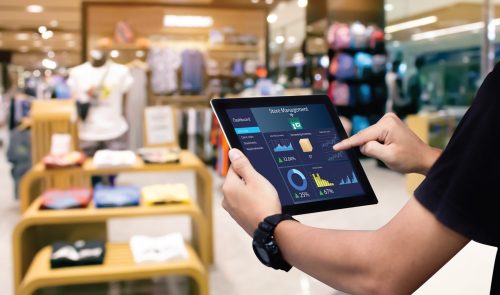
Why enterprises need real-time operational visibility beyond traditional system records.
Every enterprise runs on movement.
Products move from factories to warehouses. Cartons move from distribution centres to stores. Tools move across production floors. Files move between departments. Vehicles move through gates, yards, checkpoints, and highways. In every industry, business performance depends on how accurately these physical movements are captured, validated, and converted into decisions.
Yet, many enterprises still face a serious gap between what their digital systems show and what is actually happening on the ground.
An ERP may say the inventory is available. A WMS may show a shipment as dispatched. A POS may confirm a sale. But if the physical movement behind these transactions is delayed, missed, manually entered, or incorrectly captured, the business is still operating with incomplete truth.
That is where the next phase of enterprise visibility begins.
Not with more dashboards. Not with more manual reports. But with the ability to convert physical movement into digital truth.
The Visibility Gap in Modern Operations
Most enterprises have already invested in digital systems. ERP, WMS, POS, CRM, TMS, and analytics dashboards are now common across industries. These systems are powerful, but they depend on one important input: accurate physical-world data.
When that data is delayed or manually captured, the system becomes a record of what was reported, not necessarily what happened.
This creates operational blind spots such as:
Inventory present physically but missing digitally
Stock visible in the system but unavailable on the shelf
Shipments moved without real-time validation
Assets misplaced across departments or locations
Files delayed without clear ownership
Vehicles entering or exiting without automated identity capture
Errors detected after the process has already moved forward
At small scale, such gaps may look manageable. At enterprise scale, they become expensive. They affect replenishment, customer experience, compliance, labour productivity, audit readiness, and management confidence.
The real question for modern enterprises is no longer, “Do we have data?”
The question is, “Can we trust the data?”
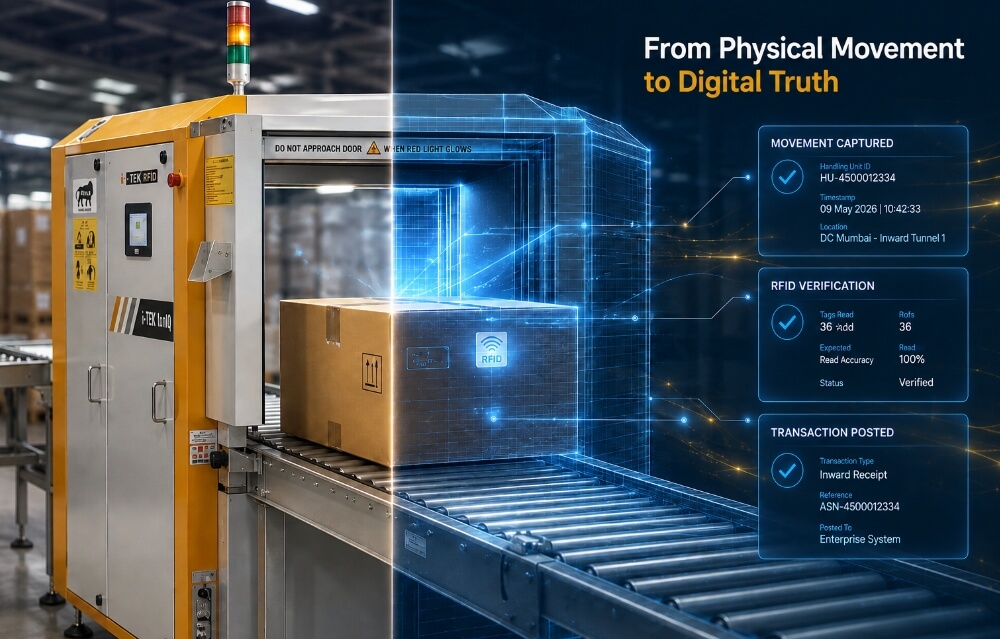
Why Physical Operations Need a Truth Layer
Digital transformation often begins with software. But operational transformation begins when software is connected to physical reality.
A truth layer is the bridge between the physical world and enterprise systems. It captures real-world events as they happen, validates them against business rules, and converts them into trusted digital records.
In practical terms, this means every critical movement can become a reliable event:
When these actions are captured automatically, enterprises reduce dependency on manual scanning, paperwork, assumptions, and delayed reconciliation.
This is the shift from transaction recording to operational intelligence.
RFID Is Not Just Identification. It Is Operational Context.
RFID is often understood as a technology for identifying tagged items. But in modern enterprise environments, its value goes far beyond identification.
A scan is not valuable only because it detects a tag. It is valuable because it tells the business what happened, where it happened, when it happened, whether it was expected, and what action should follow.
That context is what transforms RFID from a reading technology into a business intelligence enabler.
For example, the same RFID read can carry different business meaning depending on where it occurs. At a vendor station, it may confirm source tagging. Inside an RFID tunnel, it may validate dispatch. At a warehouse gate, it may confirm inward movement, while on a smart shelf, it may indicate product availability. At a POS counter, the same technology may trigger sold marking and inventory deduction. In a fitting room, it may reveal customer trial behaviour, and in a secured zone, it may raise an exception alert.
The power of RFID lies not only in capturing identity, but in attaching business meaning to physical movement.
The Role of Intelligent Edgeware
For enterprises to create trusted operational visibility, RFID readers alone are not enough. Different processes require different types of sensing systems.
This is where intelligent edgeware becomes important.
Edgeware brings RFID capture closer to the actual point of action. It combines hardware, sensors, local processing, workflow logic, and platform connectivity to ensure that the right event is captured in the right operational context.
Instead of deploying generic readers everywhere, enterprises can design purpose-fit visibility layers across touchpoints, zones, bulk operations, and infrastructure points.
This makes RFID more practical, scalable, and business-aligned.

From Read Events to Business Events
The real transformation happens when RFID reads are no longer treated as isolated technical signals.
A read event becomes powerful when it is validated and converted into a business event.
That means the system does not simply detect a tag. It checks whether the item belongs there, whether the movement is expected, whether the quantity matches, whether the document is valid, whether the item has been sold, whether the tag has been decoded, or whether an exception must be raised.
This shift enables enterprises to move from passive visibility to active control.
Examples include:
This is where operational data becomes actionable intelligence.
Why This Matters Across Industries
The need for physical-to-digital visibility is not limited to one sector.
In retail, it improves inventory accuracy, shelf availability, product search, replenishment, fitting room analytics, checkout speed, and customer experience.
In manufacturing, it supports work-in-progress tracking, tool movement, material flow, quality checkpoints, and production visibility.
In logistics and transport, it enables gate automation, shipment validation, yard visibility, carrier tracking, and movement traceability.
In healthcare and pharmaceuticals, it improves asset visibility, controlled inventory, medicine traceability, and compliance readiness.
In banking, finance, and administration, it enables secure file tracking, document custody, and audit-ready movement records.
In defence and critical operations, it supports accountable movement of assets, files, vehicles, tools, and high-value inventory.
The industries may differ, but the challenge remains the same: physical movement must be visible, validated, and trusted.
i-TEK’s Perspective: Building Trust Between Physical and Digital
At i-TEK, the focus is not simply on deploying RFID. The focus is on helping enterprises build confidence in their operations.
Through Garuda Vigil and the Skanixa intelligent reader and edgeware ecosystem, i-TEK enables businesses to capture real-world events, validate them through workflows, and connect them with enterprise systems such as ERP, WMS, POS, and other business applications.
This approach helps organizations move beyond fragmented automation. It creates an integrated operational visibility layer where products, assets, files, vehicles, handling units, and business processes can be connected through trusted data.
The outcome is not just faster scanning.
The outcome is better decision-making.
The Future Belongs to Connected Physical Operations
Enterprises are entering a phase where physical operations and digital systems can no longer work separately. Customers expect accuracy. Leaders expect real-time insights. Supply chains demand traceability. Compliance requires accountability. Teams need tools that reduce manual dependency and improve confidence.
In this environment, operational visibility becomes a strategic advantage.
Businesses that can see movement clearly can respond faster. Businesses that can validate events in real time can reduce errors. Businesses that can trust their data can make better decisions.
The future of enterprise operations will not be defined only by how much data companies collect. It will be defined by how accurately they convert physical reality into digital intelligence.
That is the journey from physical movement to digital truth.